The Emergent Grid
More than 560 million people in sub-Saharan Africa lack electricity. Renewable energy mini-grids can help reach underserved communities far from the electric grid, but these small power projects’ early years can be difficult to finance: they are often built for future demand, leaving some power unused while household and business electricity use grows. The Emergent Grid tests whether using that surplus energy to sell computing power globally can help make reliable, affordable electricity more sustainable for the underserved community.
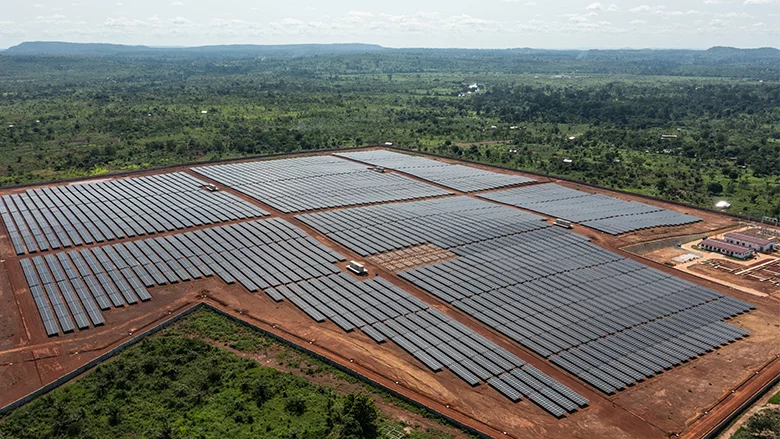
The idea is to place small, modular computing equipment alongside a mini-grid. It could use electricity that would otherwise go unused, or be paired with new power generation designed to serve both community needs and digital demand. Customers would pay for the computing service, creating a reliable source of revenue for the energy system. If the model works, that revenue could reduce subsidy needs, strengthen project finances, and attract investment to expand electricity access.
Read the launch announcement →
Read a blog on the Emergent Grid by CEO of the Mission 300 Accelerator Andrew Herscowitz →
How the model works
Each link in this chain—technical operation, customer demand, financial benefit, and community impact—will be tested in practice.
Learning across different energy systems
The initial demonstrations include sites in Sierra Leone, Kenya, and the Democratic Republic of Congo. They will test different starting points: adding computing to existing systems with underused generation and developing new solar-plus-storage systems alongside community electricity service. Independent evaluation will establish what the sites actually deliver, for whom, and under what conditions.
Community electricity comes first
Households, businesses, schools, clinics, and other essential services have priority. Computing equipment must be separately controllable so its electricity use can be reduced or stopped when the community needs power. The demonstrations will track affordability, reliability, hours of service, and community feedback. They will also assess site-level environmental and safety issues, including heat, noise, and equipment disposal.
What will the demonstration test?
Technical performance. Can flexible computing operate alongside distributed renewable energy without disrupting community service?
Financial viability. Can computing customers provide enough durable revenue to improve project economics and reduce subsidy needs?
Community benefit. Does the approach expand or strengthen affordable, reliable electricity access? Does it support connectivity, local enterprise, and other measurable opportunities?
Potential to replicate. Where the model works, can developers and investors apply it elsewhere with less philanthropic support?
Measure first. Share what we learn.
Independent monitoring and evaluation will examine electricity access, reliability, affordability, project finances, connectivity, and community outcomes. Findings will show where the approach is useful, where it falls short, and why. Projected benefits are hypotheses, not measured results.
The Emergent Grid is a demonstration initiative developed by the Mission 300 Accelerator, housed in RF Catalytic Capital, the charitable affiliate of The Rockefeller Foundation. Its findings could inform efforts to make energy access projects more sustainable and investable, including work associated with Mission 300.
Computing is the tool being tested. Reliable, affordable electricity and the opportunities it creates for communities are the goal.
Instead of driving up the cost of electricity, the global demand for digital compute could make electricity available, reliable, and affordable for people anywhere in the world. That’s the Emergent Grid: compute powered from anywhere in the world."